

Most outbound teams in 2025 still measure success with one metric: replies.
But replies capture only a small part of what outbound really creates.
Outbound isn’t just a “send → reply → meeting” process anymore, it’s an awareness engine that shapes how buyers discover, research, and evaluate products long before they ever respond.
Modern buyers move fast, act independently, and convert across multiple touchpoints: email, LinkedIn, website, product pages, without ever replying to an SDR.
Yet most outbound systems still measure success like it’s 2015, tracking only inbox activity.
That’s why so much of outbound’s real impact goes unreported.
Why Reply-Based Attribution Fails
Today’s buyers rarely reply before taking action.
They:
- Visit your website
- Sign up for a free trial
- Follow your company on LinkedIn
- Share your email internally
- Add your product to their evaluation list
Outbound still drives those actions but traditional attribution doesn’t connect them.
When teams only count replies, they:
- Underestimate outbound’s true contribution
- Kill angles that are actually working
- Lose visibility into product-led conversions
- Misallocate budgets based on incomplete data
Outbound is no longer a single-channel play. It’s a multi-touch awareness layer that fuels pipeline across your entire GTM motion.
To measure it correctly, you need a framework that captures the full influence path, from the first outbound touch to the final signup.
Why Traditional Outbound Tracking Fails
Outbound used to be simple: send an email, get a reply, book a meeting.
That model no longer fits how buyers behave.
Modern buyers prefer asynchronous exploration, they click, search, and convert on their own timeline.
The result: outbound still drives conversion, but it happens outside the inbox.
Here’s what most teams miss:
- Prospects visit your site after seeing your name in an email
- They check pricing, read docs, or start a free trial
- They convert days later, logged as “Direct” or “Organic” in your CRM
Outbound created the intent, but the system gives credit elsewhere.
This is the invisible gap where most outbound-driven conversions disappear.
Fixing the Attribution Gap
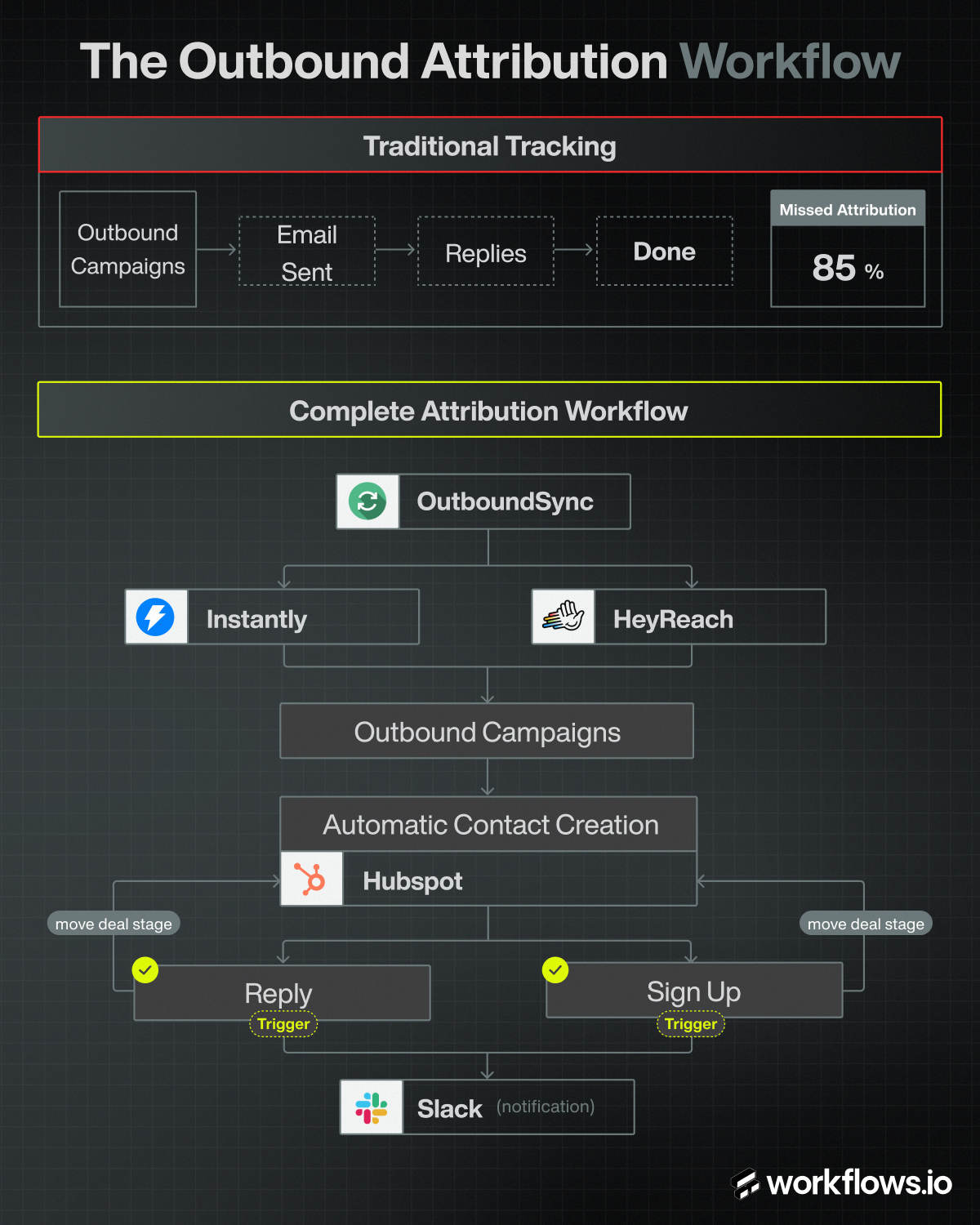
To measure outbound accurately, you need a system that connects every outbound touchpoint to every downstream conversion, even if the buyer never replies.
That means building a simple, automated layer between your outreach tools and your CRM that tracks influence across the full funnel: from first message to signup to revenue.
Here’s how to build it, step by step.
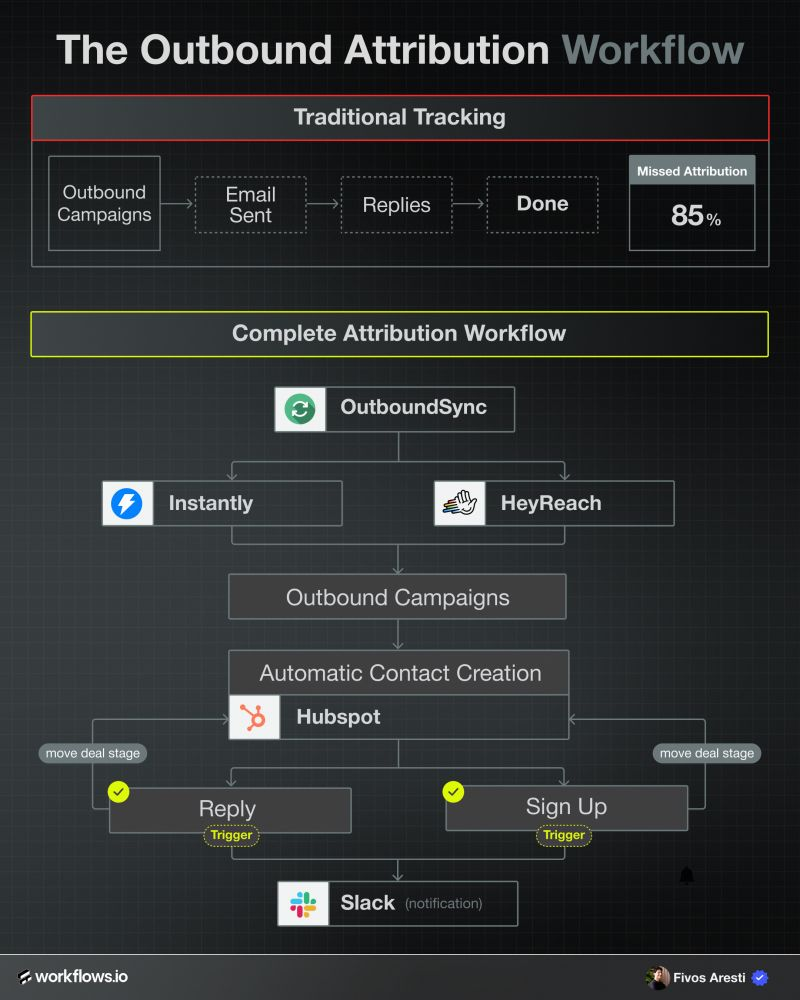
Step 1: Connect OutboundSync With Your Outreach Tools
The first step to fixing outbound attribution is simple: make sure every outbound touch is captured inside your CRM.
OutboundSync acts as the bridge between your outreach tools and HubSpot, turning every email, DM, and connection request into structured CRM data.
Once connected:
- Every Instantly email sent is logged
- Every HeyReach connection request and DM is recorded
- Every outbound touchpoint automatically creates or updates a contact in HubSpot
This solves the biggest attribution problem: leads never making it into the CRM because they didn’t reply.
With OutboundSync, the moment an outbound touch happens, HubSpot gets a new contact record, complete with metadata and timestamps.
No manual logging. No dependency on replies.
It’s the point where outbound stops being a black box and becomes fully visible.
Step 2: Create Two HubSpot Properties That Anchor Attribution
To make outbound measurable, the CRM needs to recognize two key signals:
- Outbound Campaign → marks if the contact or company was touched by outbound
- Sign Up → tracks if that contact later signed up or converted
These two simple checkboxes power the entire attribution framework.
Outbound Campaign toggles automatically when an email or DM is sent.
That means every contact and company touched by outbound is permanently marked as outbound-influenced.
Sign Up flips when a user signs up for a free trial, product, or form.
Checkboxes are lightweight, consistent, and avoid data conflicts.
Once both are in place, HubSpot instantly knows:
- Who received outbound
- Who signed up
- Where the two overlap
This is the foundation that allows all later reporting to work seamlessly.
Step 3: Auto-Tag Every Contact and Company
Once the properties exist, automation takes over.
Every time an outbound message goes out: email or LinkedIn, HubSpot automatically:
- Tags the contact as “Outbound Campaign = TRUE”
- Tags the company as “Outbound Campaign = TRUE”
Most attribution fails because CRMs focus only on individual contacts, while real buying happens at the account level.
By tagging both, you build a complete picture of:
- When outbound occurred
- Who was contacted
- From which campaign
- And what actions followed
This turns fragmented outreach data into a structured account-based attribution model.
Step 4: Track Signups Automatically and Tie Them to Outbound
Once outbound influence is logged, the next step is catching conversions as they happen.
When a user signs up, via your website, trial form, or product, HubSpot automatically updates Sign Up = TRUE.
That single change triggers:
- A Slack notification to the GTM team
- Automatic deal creation or stage update
- Attribution linking the signup to the original outbound touch
So instead of showing up as “Direct” or “Organic,” the signup is correctly recognized as:
Outbound Influenced Signup
This is how you uncover the silent conversions, the ones driven by outbound but never replied to.
Step 5: Automate Deal Stages and Reporting
Once outbound influence and signups are both tracked, you can map the entire buyer journey automatically.
Deals progress through clearly defined stages such as:
- Outbound Influenced
- Signed Up
- Product Activated
- Discovery Booked
- Closed Won
Each stage shift is powered by real activity, not manual updates.
Finally, dashboards surface the full picture:
- Total outbound-influenced signups
- Outbound → Signup → Activation flow
- Campaign-level performance
- Outbound’s contribution to pipeline and revenue
- Which channels (email, LinkedIn, DM) perform best
At this stage, outbound stops being a guessing game.
It becomes a measurable, data-driven revenue engine.
Why This Framework Fixes Outbound Attribution
Modern outbound is no longer a simple “email → reply → meeting” system.
It’s a multi-touch awareness engine that builds recognition and intent across channels: email, LinkedIn, product pages, and search.
Most prospects won’t reply, but they will take action: visiting your site, signing up for a trial, or checking pricing pages, all influenced by your outreach.
This framework works because it captures that entire chain of influence, not just the visible reply.
It treats outbound as a connected ecosystem, not a single event.
Below is how it fixes what traditional outbound tracking gets wrong.
1. Tracks Both Explicit and Silent Conversions
Traditional outbound attribution only measures what’s easy to see: replies, DM responses, or call acceptances.
But the majority of real impact happens quietly.
A prospect reads your email.
They don’t reply.
But they remember your name.
Later, they visit your site, check pricing, and sign up for a trial, without ever responding.
No reply.
No direct click.
But definitely influenced by outbound.
This framework captures both:
- Explicit signals: replies, DM responses
- Silent signals: signups, demo requests, product activations, form submissions
Because both are connected to the same “Outbound Campaign = TRUE” tag in HubSpot, the system knows instantly:
“This signup came from someone influenced by outbound, even if they never replied.”
That’s how you stop missing the majority of outbound-driven conversions that slip through the cracks.
2. Captures Full-Funnel Influence
Outbound doesn’t just book meetings.
It builds awareness, trust, and familiarity, often long before a buyer is ready to talk.
A typical path might look like this:
- They see your outbound email.
- They check your LinkedIn.
- They see your company post or remarketing ad.
- A week later, they sign up on your site.
Most systems would log that as “Direct” or “Organic.”
This framework shows the truth, outbound started the journey.
By tracking touches across both contact and company levels: via email, LinkedIn, and CRM, you create a full-funnel attribution layer that recognizes how outbound and marketing work together, not apart.
Outbound drives awareness.
Marketing captures it.
Both share the credit.
3. Aligns Outbound and Marketing Around the Same Data
When attribution breaks, so does alignment.
- Marketing claims every signup.
- Outbound only counts replies.
- Leadership sees incomplete reports.
- Teams optimize for different outcomes.
This model fixes that with shared visibility.
Because outbound influence is logged early and consistently, the CRM becomes a single source of truth:
- Marketing sees how outbound primes accounts.
- Outbound sees how marketing accelerates awareness.
- Leadership sees how both drive real revenue.
The result: one shared GTM engine measured by one attribution model, not disconnected dashboards.
Outbound and marketing stop competing for credit and start compounding results.
What Most Teams Still Don’t Measure
Even the best outbound programs often miss the majority of the impact they create.
That’s because most attribution models still assume outbound performance is visible through replies, booked calls, or CRM activity.
But the truth is: most outbound influence happens silently across website behavior, social engagement, and delayed conversions that never appear in your inbox.
This step breaks down the five signals that typically go untracked and why ignoring them leads to major under-reporting of outbound’s true performance.
1. Silent Website Conversions
The most common blind spot: website actions triggered by outbound.
A prospect receives your email, doesn’t respond, but later:
- Visits your homepage
- Checks pricing
- Reads your docs
- Signs up for a free trial
They don’t click from the email itself, they type your brand directly into Google.
Without attribution tags or CRM mapping, these conversions get labeled as:
“Direct,” “Organic,” or “Unknown.”
But the truth is, outbound created the intent.
Tracking and connecting these site conversions back to outbound-sourced contacts reveals how many “organic” leads are actually outbound-influenced.
2. The LinkedIn Effect
LinkedIn has quietly become one of the biggest outbound multipliers but most teams never measure it.
Prospects often:
- See your profile or comments
- Notice your company content
- Recognize your brand from repeated exposure
Even if they ignore the initial email, those LinkedIn touchpoints build familiarity and trust, often becoming the deciding factor for when they finally sign up.
When outbound contacts are enriched with LinkedIn URLs and synced across tools like HeyReach, this influence becomes measurable.
Ignoring it means you miss the social layer of outbound impact, the one that drives credibility before a conversation even starts.
3. Off-Channel Conversations
Modern buyers don’t stay in one channel.
Outbound conversations often move to:
- LinkedIn DMs
- Twitter/X messages
- Slack communities
- WhatsApp or personal channels
A prospect may read your email, skip replying, and then message you elsewhere.
If your CRM only listens to the inbox, this conversion disappears.
By syncing off-channel activity into the same contact record, you capture the real path to conversion, not just the one your automation can see.
Outbound started the conversation. The channel just changed.
4. Brand Familiarity and Compound Influence
Outbound doesn’t just generate meetings, it builds brand memory.
Here’s what a real buyer journey looks like:
- They get your cold email → ignore it.
- They see your company twice on LinkedIn that week.
- They notice your founder’s content.
- They click a retargeting ad.
- Then, finally, they sign up.
That’s not one action, it’s five exposures leading to one conversion.
Without persistent outbound tags on contacts and accounts, this compound influence never shows up in reports.
Yet, this “slow awareness buildup” is what drives most modern conversions.
5. Delayed Conversions and Long-Tail Impact
Not every conversion happens instantly.
Outbound often plants intent that activates weeks later.
Prospects might:
- Sign up after multiple touches
- Reply weeks after the sequence ends
- Convert once timing or budget aligns
If attribution only measures short-term outcomes, these long-tail conversions vanish.
Tracking at the contact and company level ensures outbound influence isn’t lost over time because awareness today often becomes pipeline tomorrow.
Conclusion
Most outbound teams underestimate their true performance not because their campaigns are weak, but because they’re measuring the wrong things.
Replies only tell a small part of the story.
Across industries, replies account for just 10–20% of total outbound-driven conversions.
The real impact: free trials, demo requests, signups, and product activations happens quietly, outside the inbox and after the initial touch.
Outbound today is not a one-step “email → reply” motion.
It’s a multi-touch awareness system influencing buyers across email, LinkedIn, websites, and product experiences.
When teams fail to capture that, they misjudge performance, pause campaigns that are actually working, and make GTM decisions with incomplete data.
Fixing outbound attribution isn’t about more tools, it’s about designing a system that reflects how modern buyers behave:
- Buyers convert silently. They prefer self-serve actions, not email threads.
- Influence compounds. Every email, LinkedIn touch, and brand impression adds up.
- Attribution must evolve. If your CRM only tracks replies, you’re losing visibility on most of your pipeline.
Teams that close this attribution gap see immediate lift in forecasting accuracy, pipeline visibility, and strategic clarity.
They finally see what’s really working, not just what’s visible.
When outbound is measured correctly, it stops being a guessing game.
It becomes a predictable, scalable acquisition engine.
At Workflows.io, we help revenue teams build complete outbound attribution systems, connecting outreach, CRM, and product data into one clear, measurable flow.
We design and deploy frameworks that:
- Capture every outbound touch automatically
- Attribute silent signups and product activations accurately
- Sync real-time data across HubSpot, LinkedIn, and email
- Visualize outbound’s true revenue impact end-to-end
Your outbound motion shouldn’t just send, it should compound.
With the right attribution system in place, every campaign becomes measurable, every conversion traceable, and every signal visible inside your CRM.






.svg)