.jpg)


Introduction
Account-Based Marketing (ABM) is a go-to-market strategy that brings marketing, sales, and operations together around a focused set of high-value accounts.
It’s built on precision targeting, personalized engagement, and clear revenue outcomes.
Most teams don’t struggle with ABM strategy, they struggle with execution.
Many know how to define an ICP or build a target list, but few know how to run ABM inside the CRM, automate intent signals, or route real buyer activity to sales in real time.
The 2025 ABM Playbook is designed to close that gap.
It outlines a 90-day framework for building a complete, working ABM system covering ICP modeling, data enrichment, signal tracking, and account prioritization.
Each step is mapped to real tools, workflows, and automations that can be applied across any GTM stack.
Whether you’re building your first ABM motion or optimizing an existing one, this playbook is built to deliver three measurable outcomes:
- Accurate ICP segmentation and scoring to focus effort on high-potential accounts
- Automated signal capture and enrichment across first-, second-, and third-party data
- Seller workflows powered by live intent, ensuring focus on the right accounts at the right time
Together, these elements create a data-driven ABM system that keeps your CRM accurate, your outreach focused, and your GTM team aligned around one source of truth.
Building a high-output ABM engine isn’t theoretical, it’s architectural.
The next eight steps break down how to design and operationalize that system, starting with your foundation: the Ideal Customer Profile (ICP).
Step 1: Define & Backtest Your ICP Model
Every effective ABM system starts with a clear and data-backed Ideal Customer Profile (ICP), not a guess, but a model built on evidence from real deals.
Your ICP is the foundation for everything that follows: segmentation, targeting, messaging, scoring, and prioritization.
1. Source Closed-Won + Closed-Lost Data
Start with what’s already in your pipeline. The goal is to see which types of accounts actually convert and which don’t.
Focus on two datasets:
- Closed-Won Accounts
- Identify patterns among your best customers: high-value, high-LTV, and consistent renewals.
- Go beyond firmographics. Look at deal velocity, engagement depth, product usage, and upsell potential.
- Closed-Lost Accounts
- Look for common red flags: objections, pricing issues, or drop-offs in engagement.
- These insights help you recognize segments that consistently underperform.
Then, talk to your frontline teams: your AEs and CSMs.
They’ll share the qualitative insights that don’t live in your CRM: stories, objections, or buying behaviors that data alone can’t explain.
2. Build the ICP Framework
Once you’ve gathered insights, turn them into a structured model.
Your ICP should be defined across two layers:
- Firmographic Matching:
- Use tools like Apollo or Clay to find companies that resemble your best-fit customers by headcount, funding stage, location, or tech stack.
- Lookalike Modeling:
- Use AI discovery tools or web scrapers to identify net-new accounts that behave like your ICP — even if they aren’t in your CRM yet.
3. Backtest Your Model
Now it’s time to validate your assumptions.
Run your ICP against historical data to see if accounts that fit your model have:
- Higher conversion rates
- Shorter sales cycles
- Stronger retention or expansion patterns
If not, adjust the parameters until your ICP consistently predicts success.
Once it’s backtested, your ICP becomes the foundation for your Target Account List (TAL), the dataset that powers every next step in your ABM workflow.
Step 2: Map & Segment Your TAM
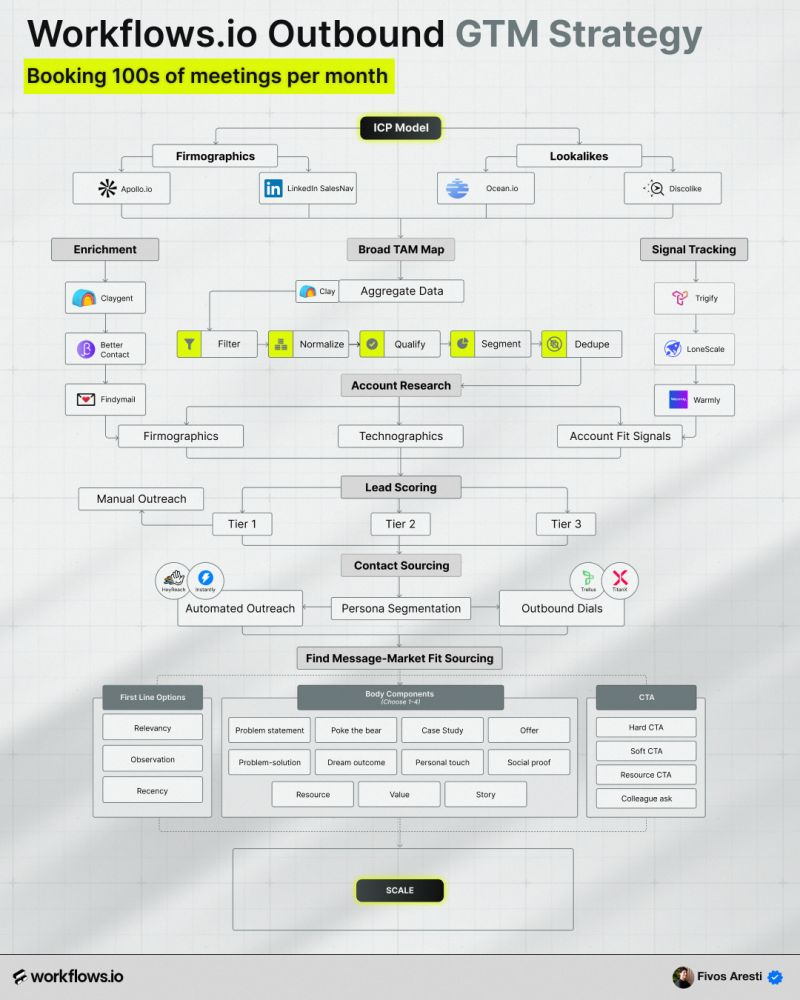
Once your ICP model is validated, the next step is to scale it across the market mapping your Total Addressable Market (TAM) and filtering it into a targeted, enriched, and tiered account list (TAL) that aligns with your GTM goals.
1. Build Your TAM Map
Start by compiling a comprehensive list of accounts that match your ICP parameters.
This is your full market universe, the foundation for all downstream targeting.
How to source it:
- Firmographic Matches: Use platforms like Apollo, Sales Navigator, or Clearbit to find companies that align by industry, headcount, region, or funding stage.
- Lookalike Discovery: Tools like Ocean.io or DiscoLike can surface companies that behave like your best customers, even if they’re outside your known pipeline.
- Data Supplements: Scrape niche directories, event lists, or curated databases to catch overlooked but relevant accounts.
The result is a structured, verified TAM dataset ready for enrichment.
2. Enrich for Tiering
A raw TAM list is just data, enrichment turns it into intelligence.
The goal is to add depth and context so each account can be scored, segmented, and prioritized.
Enrichment layers to apply:
- Firmographics: Add location details, sub-industries, growth rate, and hiring trends.
- Technographics: Map tech stack, key integrations, and complementary tools.
- Fit & Intent Signals: Layer in social engagement, content interaction, or activity triggers like funding events or leadership hires.
Once enriched, your TAM becomes a dynamic view of your market, ready to be tiered based on fit and potential.
3. Apply a Tiering Model
Not all accounts deserve equal effort. Tiering ensures that time, budget, and personalization are matched to potential value.

This tiering ensures your budget, tools, and seller focus are distributed by expected ROI.
4. Operationalize in Your CRM
Once your Target Account List (TAL) is tiered and enriched, it’s time to activate it inside your CRM.
This step turns your static data into a live, evolving system by enabling:
- Dynamic scoring and signal tracking
- Tier-based automation workflows
- Unified visibility for marketing, sales, and ops
Inside your CRM, your TAM becomes a living dataset, continuously updated, measurable, and ready for activation through signal tracking and awareness scoring.
Step 3: Set Up Intent & Signal Tracking
Signal tracking is what turns a static account list into a living buyer journey.
Once your Target Account List (TAL) is enriched and tiered, the next step is to track behavioural triggers that reveal interest, urgency, or buying intent.
This layer powers everything else in your ABM motion, it’s where strategy meets timing.
1. Capture Signals Across Three Categories
To get a full picture of buyer intent, capture signals from three distinct data sources.
Each one adds a different layer of visibility into how and when accounts engage.
- First-Party SignalsThese come directly from your own systems and reflect verified user activity.Examples:
- CRM activity (email opens, replies, call logs)
- Website visits and product usage
- Webinar attendance, content downloads, demo requests
- Second-Party SignalsData shared by trusted partners or platforms extending your visibility beyond owned channels.Examples:
- Ad engagement or clickstream data
- Champion tracking (past users interacting with your content)
- Partner platform or referral activity
- Third-Party SignalsPublic or aggregated data that highlights external buying activity.Examples:
- Tech-stack changes (e.g., adding or replacing a competitor)
- Hiring patterns, leadership changes, or new funding rounds
- Mentions in market news or category trend spikes
2. Centralize Signals in Your CRM
Signals only create value when they’re connected and visible.
Every data source should feed directly into your CRM mapped against accounts and contacts with clear attribution.
Implementation checklist:
- Log each signal with a timestamp and category (fit, activity, or intent).
- Enable dynamic list creation and automation triggers when engagement crosses set thresholds.
- Use these inputs to refine lead scoring, awareness stages, and pipeline prioritization.
When centralized, your CRM becomes more than a database, it becomes a real-time intelligence layer that guides GTM decisions.
3. Route Real-Time Alerts to Slack
Speed determines conversion.
Signals should reach reps instantly in the tools they already use.
Best practices:
- Send high-priority alerts (like Tier 1 accounts visiting pricing pages) to dedicated Slack channels.
- Map CRM owners to Slack user IDs for personalized notifications.
- Automate follow-ups with Slack workflows that create tasks, surface account digests, or prompt next steps.
Step 4: Model Awareness Progression
ABM isn’t just about finding the right accounts, it’s about understanding where each account is in its buying journey.
Once signal tracking is in place, the next step is to translate engagement into measurable awareness levels.
This process, known as awareness scoring, turns raw activity into a structured way to assess buyer readiness and prioritize action.
A strong awareness model transforms scattered signals into a clear, visual map of your pipeline, showing which accounts need nurturing and which are ready for sales activation.
The Awareness Scoring Funnel
An awareness scoring funnel classifies accounts as cold, warm, or active based on their engagement depth and behaviour patterns.
The model below breaks this progression into five stages, each representing a different level of awareness and intent:

Step 5: Source & Segment Contacts
In ABM, companies don’t make buying decisions, people do.
That’s why success depends on identifying the right stakeholders within each target account and understanding their roles, influence, and decision power.
This step builds a clear contact framework so your outreach is personalized, multi-threaded, and tiered by influence.
1. Build the Stakeholder Map
Every target account should have a defined buying committee, the group of people who evaluate, approve, and champion your solution internally.
Typically, these personas fall into three tiers:

Having this map gives your team clarity on who to engage, how to engage them, and what level of effort each persona deserves.
2. Source and Enrich Contact Data
Once your stakeholder framework is set, the next step is finding and enriching those contacts.
Use AI-powered sourcing tools like Clay, Apollo, or Findymail to pull verified contact details and enrich them with relevant data.
Focus on:
- Populating verified emails and phone numbers.
- Tagging each contact by Persona Type, Seniority, and Influence Tier in your CRM.
- Prioritizing Tier 1 and Tier 2 personas for personalized outreach and sequencing.
High-quality contact data ensures your automation and personalization stay accurate and your reps focus on the people who matter most.
3. Connect Stakeholders to Accounts
After enrichment, link every contact directly to their account record in your CRM.
This connection turns static data into actionable account intelligence.
It enables:
- Account-based cadences tailored to each persona type.
- Contact-level scoring that reflects engagement and seniority.
- Multi-threaded outreach across marketing and sales for better deal coverage.
This structure helps your team engage the full buying committee not just one contact increasing deal velocity and win rates.
Step 6: Orchestrate Demand Generation by Tier
Once your accounts are enriched, tiered, and mapped to the right contacts, it’s time to activate them.
This is where ABM moves from design to execution, where strategy turns into motion.
Tier-based orchestration ensures your time, budget, and personalization align with the expected value of each account. The goal is simple: spend your energy where it will create the most impact.
1. Design Tier-Based Playbooks
Each tier deserves a different level of personalization, automation, and creative investment.Think of it as matching effort to opportunity.
Tier 1 (1:1 Plays)
Your must-win accounts.
These deserve focused attention and a personalized experience that builds real consensus within the buying committee.
Recommended Plays:
- Warm introductions through investors, customers, or partner networks
- Custom gifting or direct mail tailored to key stakeholders
- Personalized microsites or landing pages built for each account
- Short, tailored video messages from an AE or founder
- Invitations to private events or exclusive webinars
- Role-specific content and thought leadership assets
- Manual, multi-channel outreach (email, phone, LinkedIn)
Objective:
Deliver a high-impact, personal experience that accelerates buying intent and builds deep engagement across decision-makers.
Tier 2 & 3 (1:Many Plays)
These accounts don’t require full personalization but still need regular, relevant engagement.
Here, the goal is to drive awareness, capture signals, and surface buying intent efficiently and at scale.
Recommended Plays:
- Automated outbound and nurture sequences
- Paid social and retargeting campaigns
- Personalized video outreach at scale (using tools like Vidyard or Sendspark)
- Role-based or segment-based landing pages
- Co-marketing with partners or community-driven campaigns
- Targeted newsletters, webinars, or educational drip flows
Objective:
Warm up larger account segments, identify new intent signals, and promote high-engagement accounts into Tier 1 for deeper, personalized follow-up.
2. Balance Personalization and Scale
The key to effective orchestration is calibrating effort.
Use this balance as a rule of thumb:
- Tier 1 → Creativity + Human Effort
- Tier 2 → Automation + Smart Personalization
- Tier 3 → Awareness + Scalable Reach
Track performance continuously monitor CTR, response rates, meetings booked, and awareness score progression.
Then, shift resources to wherever engagement and intent are compounding fastest.
Over time, this creates a living demand engine, one that expands reach without losing precision.
Step 7: Align GTM with CRM & Slack
Once your demand engine is running, every interaction, signal, and stage shift needs to flow back into your core GTM systems.
This alignment turns scattered activity into a single layer of intelligence, powering real-time action, accurate reporting, and seamless collaboration across teams.
When CRM and Slack are properly connected, GTM teams move faster, stay aligned, and never miss a signal that could drive pipeline.
1. Centralize Everything in Your CRM
Your CRM is the operating system of ABM, the single source of truth where every account, contact, and signal comes together.
All enriched data should be continuously updated, searchable, and reportable.
Key components to track:
- Account Score → Combines fit, intent, and engagement level
- Persona Tier → Decision Maker, Champion, or End User
- Awareness Stage → Where the account sits in the buying journey (Identified → Selecting)
- Signal Logs → Timeline of behavioral and intent triggers
- Stakeholder Map → Linked contacts with defined roles and influence tiers
Why this matters:
- Enables dynamic list building for campaigns and reporting
- Triggers automated workflows (like task creation or deal advancement)
- Ensures smooth handoffs between marketing, sales, and customer success
2. Automate Real-Time Alerts in Slack
While the CRM stores data, Slack drives action.
Pushing critical insights to Slack keeps reps informed the moment something happens like a job change, a spike in engagement, or a key signal from a Tier 1 account.
Implementation checklist:
- Route high-priority signals (e.g., pricing page visits, ad engagement) to dedicated Slack channels
- Map CRM owner IDs → Slack user IDs for rep-specific alerts
- Send daily or weekly summaries (e.g., Tier 1 Account Digest)
- Trigger Slack messages when awareness stages change
- Use Slack bots or emoji reactions to assign or confirm next actions
3. Build the Feedback Loop
CRM and Slack shouldn’t work in isolation. The most effective systems run on a bi-directional feedback loop.
Signals captured in the CRM trigger alerts in Slack.
Reps take action in Slack, and those actions feed back into the CRM for tracking.
The result:
- Continuous data flow between systems
- Reps acting on real-time insights
- Complete visibility for leadership across pipeline health and performance
Conclusion
Account-Based Marketing only works when it’s operationalized, when strategy is translated into systems that actually run.
This framework breaks ABM into clear, repeatable steps, moving your team from static data to structured, signal-driven execution.
Each layer builds on the last:
- ICP modeling defines focus.
- TAM mapping scales it.
- Signal tracking activates it.
- System alignment keeps it measurable.
The result isn’t a campaign, it’s a connected, data-backed process.
One where every account, contact, and signal flows through a unified system of record, giving teams shared visibility, faster motion, and consistent growth.
At this level, ABM isn’t theory. It’s infrastructure for scale
At Workflows.io, we help B2B companies build end-to-end ABM systems powered by real-time data, AI-driven enrichment, and automated GTM workflows.
Our approach turns complex processes into repeatable, scalable systems that your team can operate with clarity and confidence, directly inside your CRM.
If your goal is to turn intent into pipeline and build an ABM engine that compounds over time, Workflows.io is built to help you get there.
.jpg)

%20(1).jpg)