A practical, data-driven workflow for building, validating, and operationalizing an ICP model that every GTM team can actually use in the field.
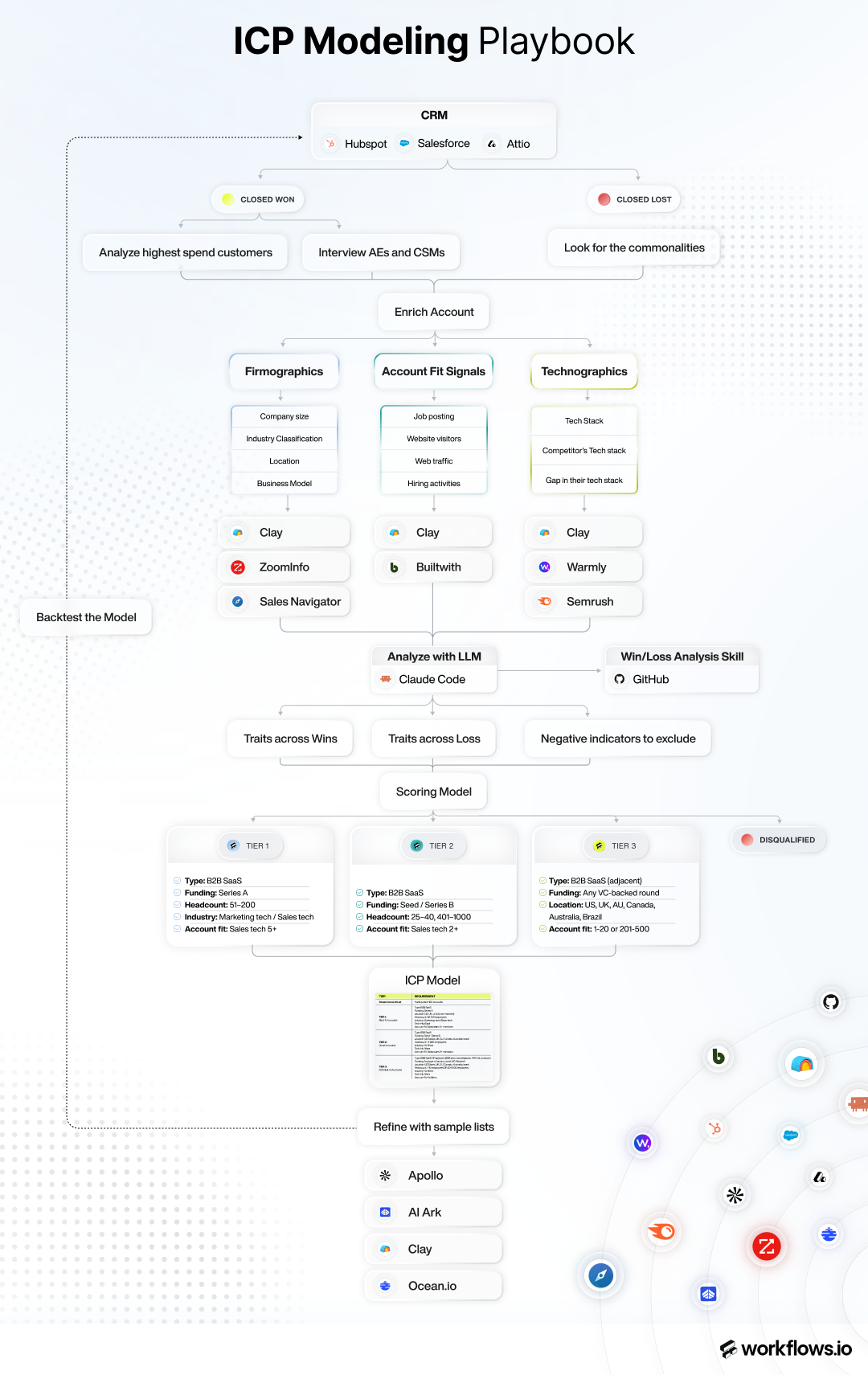
Read moreWatch video on youtube- Run a structured survey for top AEs and CSMs
- Ask who buys fast, who churns, where deals stall, who champions
- Cluster answers into patterns, not isolated stories
- Use LLMs (Claude/GPT) to summarize traits of best and worst-fit customers
- Output: a list of qualitative ICP signals (good + bad)
- Export 12–24 months of Closed-Won + Closed-Lost deals
- Enrich each account in Clay with firmographics (industry, size, funding, geo)
- Add technographics (stack, CRM, data tools, competitors, integrations)
- Optionally enrich growth + intent (hiring, traffic, jobs, reviews)
- Output: a rich historical dataset that explains why certain deals win
- Define Tier 1 / Tier 2 / Tier 3 based on fit and value
- Choose firmographic criteria (sub-industry, headcount, region, funding, growth)
- Add technographic criteria (complementary tools, maturity, stack alignment)
- Include account fit signals and negative indicators
- Turn this into a clear, shareable tiering rubric for the whole GTM org (example here)
- Implement the scoring logic as rules inside Clay
- Run it across historical deals to assign Tier 1/2/3 to every past account
- Check: do wins cluster in Tier 1 and losses in Tier 3?
- Refine signals and thresholds until tiers line up with real ACV, win rates, and cycle length
- Outcome: a model that predicts correlates with close rate and contract size, not based on assumptions
- Push tiers into CRM and make them visible on every account
- Acquisition: focus paid + ABM on Tier 1
- Manual prospecting: SDRs start with Tier 1
- Automated outbound: Tier 2 and 3
- Marketing: build messaging and positioning around Tier 1 accounts