

SaaS sells software and lets humans run it.
Services sells human time and lets software support it.
Service-as-a-software is the model that has emerged in the last 18 months. It is the one agencies betting on AI are now using to grow without growing headcount.
For 25 years, B2B agencies priced human time. The model was straightforward.
Hire smart people. Charge for their hours. Scale by adding headcount.
AI changed that math when it started doing 60 to 70 percent of the work that used to require a junior on every account.
Service-as-a-software is what replaces it. The work still gets delivered like a service. The execution runs through software.
The team is smaller because Claude does the legwork, but the output is higher because every team member ships at senior quality from day one.
This is the operating model we run at workflows.io.
This post breaks down what service-as-a-software actually means, the four layers underneath an AI-native agency, where the model compounds, and where teams trying to retrofit it onto a traditional org break down.
What service-as-a-software actually means
Service-as-a-software is a business model where the deliverable is a service but the execution runs through software.
The customer pays for outcomes: qualified meetings booked, content shipped and pipeline built.
The agency owns the relationship and the strategy. What changes is the labor mix.
In a traditional services agency, a campaign means a team of four:
- The account manager runs strategy
- A specialist builds the lists
- A copywriter writes the sequences
- A coordinator handles QA and reporting
Each campaign costs four people for two weeks.
In a service-as-a-software agency, the same campaign runs through Claude Code skills.
The strategy still lives with a senior operator. The list, the copy, the QA, and the reporting all run through skills that pull from connected MCPs and produce reviewed output.
One operator now ships what four people used to.
The pricing model does not need to change. The unit economics do.
Why traditional services break at scale
The traditional services model is bottlenecked by hiring.
Pipeline grows, hire more SDRs and AMs. Pipeline contracts, lay them off. The cost base is mostly people.
That math worked when software could not do the work. AI changes the math.
A team of 80 with the right operating layer can deliver what 250 people used to deliver. The teams still trying to scale by hiring fall behind on cost while the AI-native teams scale on operating quality.
Three problems compound at once in the old model:
- Margin erodes because labor cost stays flat while pricing pressure increases
- Quality varies because junior reps deliver at junior quality
- Knowledge walks out the door every time someone leaves
The traditional structure has no way to fix all three at the same time, because each fix tends to make another worse.
The four layers of an AI-native agency
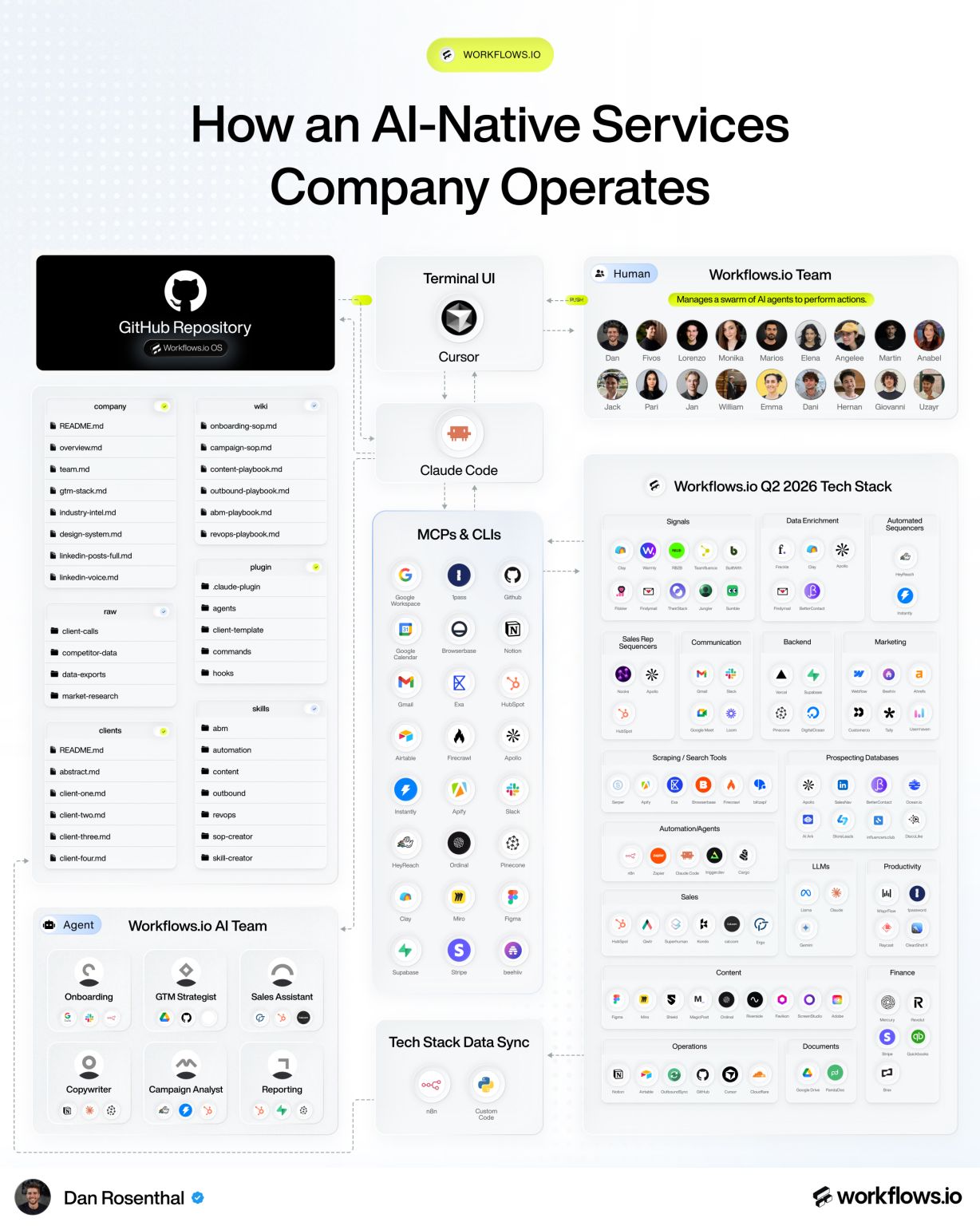
The service-as-a-software model needs four operating layers.
These are the layers we built at workflows.io and the ones every AI-native agency we work with ends up converging on.
Layer 1: The Company OS
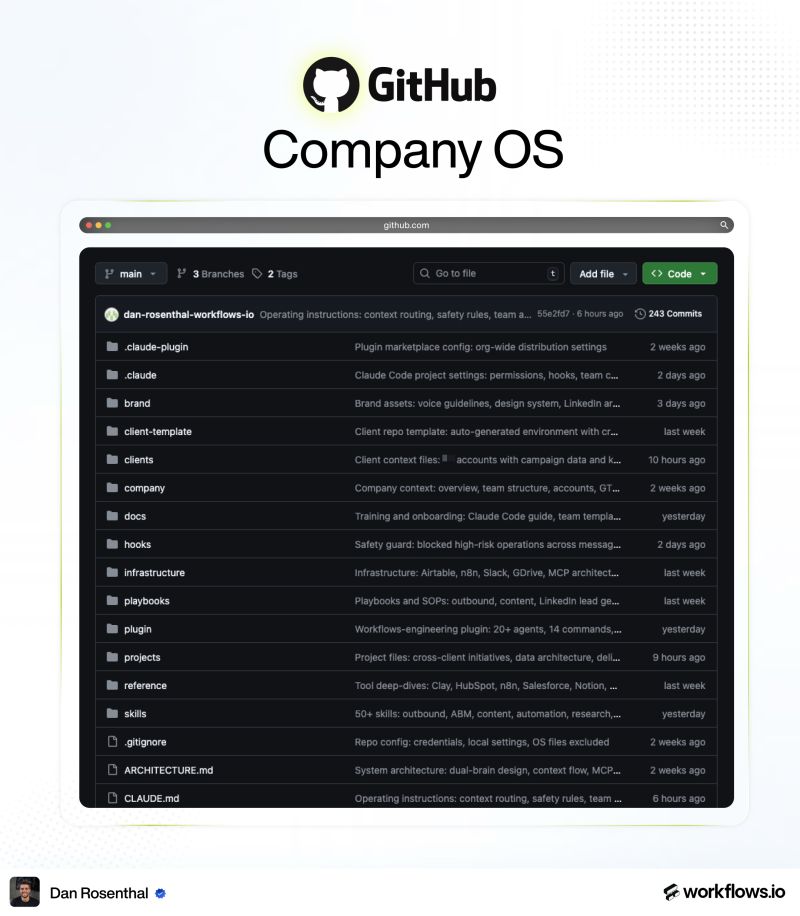
The Company OS is your team's knowledge stored as Markdown files in a GitHub repo.
SOPs, voice guides, playbooks, design systems, industry context, prompt patterns. Every Claude Code session pulls the latest version automatically.
We covered the architecture in detail in how to build a Company OS on GitHub.
The short version: knowledge stops dying in Slack and Notion, and starts running every time a team member opens their terminal.
Layer 2: Client repos
Each client gets a private repo built on the same pattern as the Company OS.
ICP, voice guide, brand assets, historical campaigns, onboarding research, Slack thread summaries, call transcripts. n8n auto-syncs the recent context so the file stays current without anyone maintaining it.
The result is that any team member starts a new session with full client context loaded.
No catch-up calls. No "let me read the doc first."
The AE, the strategist, and the copywriter all have the same context the founder had on the kickoff call.
Layer 3: The Claude Code skill library
The skill library is what lets the knowledge run.
We covered the five core GTM skills in the Claude Code skill library breakdown, covering ICP modeling, GTM strategy, outbound copy, LinkedIn content, and discovery prep.
Each skill is open-sourced in our Company OS Starter Kit on GitHub.
Clone, customize, run.
Layer 4: The MCP and CLI execution layer
MCPs let Claude act in your tools, not just advise.
The core stack we connect for service delivery includes:
- Apollo and Findymail for data
- Instantly and HeyReach for outbound execution
- HubSpot for CRM
- n8n for automation
- Pinecone for the performance database the copywriter skill queries
A skill that returns a Markdown plan but cannot act in your tools is a smarter SOP, not a service-as-a-software workflow.
The MCP layer is what closes the loop.
How the model compounds
Three things compound when you run the four layers correctly.
1. Knowledge:
Every campaign that ships gets logged, indexed, and queried by the next one. Pinecone stores past sequence performance.
The copywriter skill queries that data when it drafts new sequences. The system sharpens without anyone maintaining it.
2. Team
A senior operator authors a skill once. Every junior on the team gets the same quality output.
The senior is no longer the bottleneck on every campaign. They become the editor and reviewer instead, which is a smarter use of their time.
3. Margin
Labor cost stays flat while output per operator triples. The agency can drop pricing to win share, hold pricing to widen margin, or both.
Most service-as-a-software agencies hold pricing and take the margin expansion.
What service-as-a-software means for headcount
Most B2B services agencies run an 8 to 1 ratio of staff to revenue per million ARR.
AI-native agencies are running 2 to 1 or even 1 to 1.
The math does not require you to fire anyone. It requires you to stop hiring the next 30 people and instead invest the same payroll in operators who know how to author skills.
A service-as-a-software agency at $10M ARR runs 15 to 20 people.
At $30M ARR, 60 to 80 people.
The constraint is no longer recruiting. It is finding senior operators who can translate workflow expertise into runnable Claude Code skills.
Conclusion
Every B2B services agency has a choice in 2026.
Keep pricing human time and watch margins compress as AI does more of the work for less.
Or rebuild around service-as-a-software, where AI ships the labor and humans own the strategy and the relationship.
The agencies that move first compound. Knowledge sharpens because every campaign feeds the next. Margins expand because output per operator climbs without payroll climbing with it.
The rest are still hiring against the old model and watching the gap grow.
If you want to see what a service-as-a-software operating model looks like inside an active agency, book a strategy call. We can walk through how the four layers ship in our own delivery and what it takes to wire the same system into yours.