

B2B buyers do not follow company pages anymore.
They follow people. Their attention sits with founders who post in their own voice, not with corporate accounts that read like marketing wrote them.
The shift is happening across every category. The companies winning inbound in 2026 are doing it through their founders' LinkedIn accounts, not their corporate handles.
Founder-led marketing is the new B2B GTM motion.
The founder's personal brand becomes the company's primary distribution channel. The team's personal brands extend it. The company page sits in the background as a credibility check, not the engine.
This post breaks down why the shift is happening, what founder-led marketing actually means in operating practice, and the four-pillar playbook we run at workflows.io to wire it.
What founder-led marketing actually means
Founder-led marketing is a B2B marketing approach where the founder's personal brand carries most of the company's content distribution.
The founder posts on LinkedIn under their own name. The team amplifies. The company page exists for credibility but does not carry the load.
The deliverables look the same as traditional content marketing. Hooks, posts, threads, videos, newsletters.
What changes is the byline. The voice is human. The distribution rides on the trust readers already place in individuals over brands.
A few things shifted at once to make this happen.
LinkedIn's algorithm started favoring posts from individual accounts over company pages around 2023, and the gap has widened every year since.
AI-generated corporate content flooded inboxes and feeds, and readers started filtering on whether something sounded human.
Buyers under 40 grew up trusting individuals over institutions, and that habit followed them into B2B purchasing decisions.
Personal brand has become company brand
The old corporate marketing motion separated the company brand from the people inside it.
The company had a logo, a brand book, a voice. The employees had personal lives off the clock. The two were kept apart on purpose.
That separation does not work anymore.
The founder's voice is the company's voice. The team's individual accounts together build a richer picture of the company than any corporate post ever could.
For the content system that supports this in practice, see the complete LinkedIn growth guide.
Why founders are the new CMOs in B2B
The founder is uniquely positioned to lead a B2B company's content motion.
The founder built the product and talks to customers more often than anyone else on the team. They carry the credibility because they are the person who actually made the bet. No content writer hired in can match that combination.
A traditional CMO at a 20-person company hires writers, edits drafts, and ships content through committee. The result is content that sounds like every other B2B blog because it was filtered through every other B2B process.
A founder doing their own marketing skips all of that. They write what they actually think. The post ships in their voice because there is no committee in between.
The CMO role has not disappeared. It has shifted from "manage the content team" to "support the founder's content output." The best CMOs in 2026 are the ones who treat their founder as their highest-output channel and build the operating layer around them.
The four pillars of a founder-led marketing system
Founder-led marketing only works if you build the operating layer around it. The founder cannot maintain the cadence alone.
We run four pillars at workflows.io. These are the layers we wire for our own founders and the ones we install for clients running founder-led inbound.
Pillar 1: Voice calibration
Voice calibration is the work of capturing how the founder talks and turning it into a structured guide every other person on the team can write to.
The voice guide lives in your GitHub repo as a Markdown file. It captures specific phrasings the founder uses, formats they favor on LinkedIn, topics they have an actual point of view on, and topics they refuse to write about.
The LinkedIn post writer skill in our Company OS Starter Kit on GitHub reads this voice guide every time it drafts.
Pillar 2: Content cadence
A founder posting twice a year is not founder-led marketing.
The cadence floor is two LinkedIn posts a week, plus quarterly long-form content like newsletters or guest podcasts.
The 90-day content calendar gives the founder structure without forcing them to write everything from scratch. Topics are pre-mapped to the funnel, and each post has a hook variation ready before the founder ever opens LinkedIn.
We covered the full 90-day system in the 90-day LinkedIn content plan.
Pillar 3: Distribution and engagement
Posts do not distribute themselves. The team has to engage in the first hour.
Comments from team members in the first 60 minutes signal to the LinkedIn algorithm that the post deserves reach. We track engagement on every post through Jungler and Trigify.
Beyond the team, distribution comes from the founder engaging with their network's posts before they ship their own. The founder who engages 20 minutes a day before posting outperforms the one who only writes.
For the social selling motion that complements the content engine, see the LinkedIn social selling playbook.
Pillar 4: Team brand expansion
One founder posting is the start. A team of personal brands is the compounding layer.
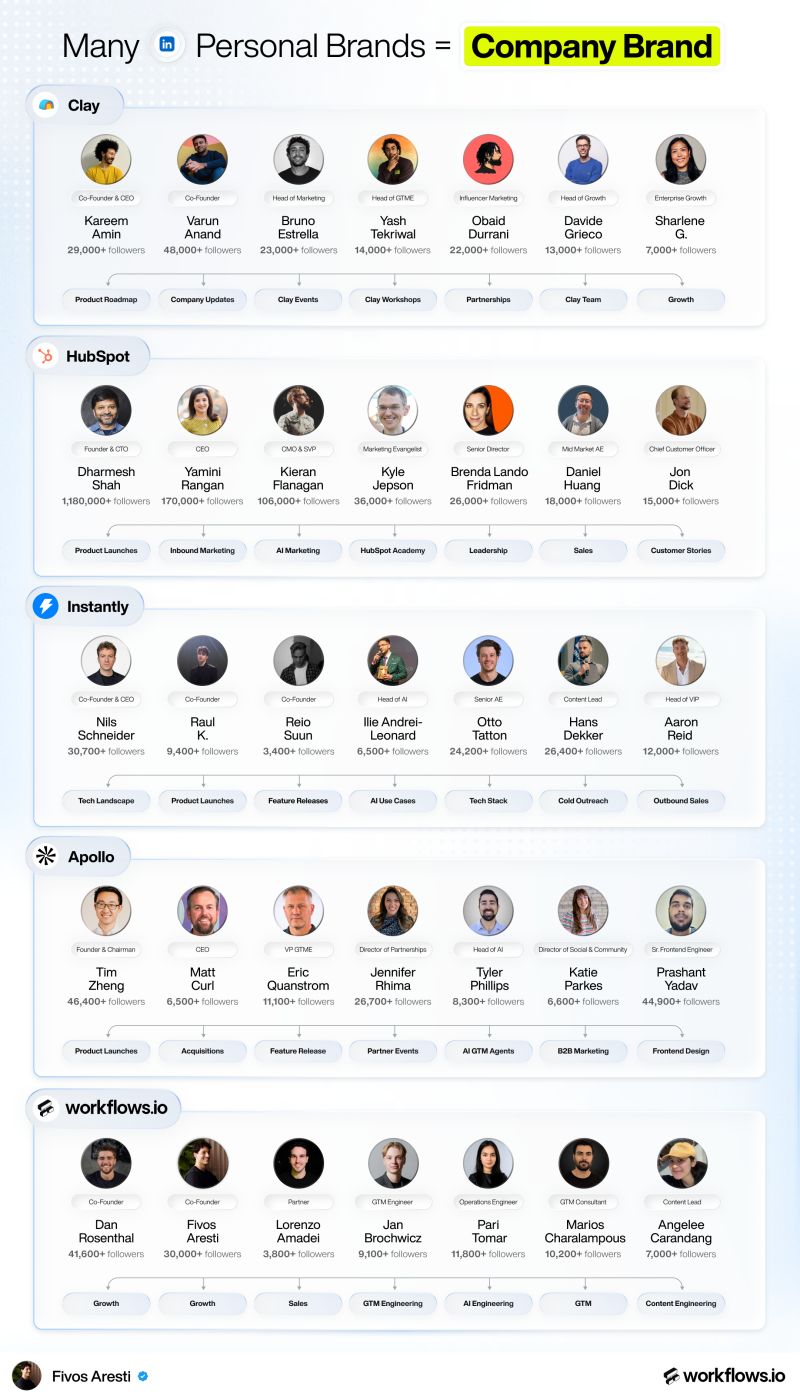
We extend the voice guide and content calendar to senior team members. Each person owns a sub-area of the brand. The founder, the GTM lead, the product lead, the engineering lead, the design lead. The brand fans out across categories without diluting because every account stays in the same operating system.
This is where the "many personal brands = company brand" thesis shows up in operating practice.
For the founder-specific motion that supports the expansion, see the founder connections playbook.
How founder-led marketing compounds with outbound
The biggest unlock from founder-led marketing is not impressions. It is the warm bridge into outbound.
When a prospect engages with the founder's content, the company knows. Jungler and Trigify capture the engagement. That signal fires an outbound sequence to the prospect or their company.
The cold email is not cold anymore. The opener references the post the prospect engaged with. Reply rates lift because the prospect already feels like they know the founder.
For the full mechanics of signal-based outbound, see the ultimate guide on outbound.
The compounding works in both directions. Outbound conversations surface topics the founder writes about next. Content posts surface accounts the team should reach out to.
Where teams get founder-led marketing wrong
A few failure modes show up when companies try to copy this model.
Treating it as a ghostwriting project:
A ghostwriter who has not absorbed the founder's voice produces content that reads like a press release with the founder's name on it. The signal is lost the moment a reader senses the bylined founder did not write it.
Asking the founder to write everything.
The founder is the voice, not the production team. They should record loose voice notes or write rough drafts, but the structuring, editing, and scheduling has to live with someone else on the team.
Treating LinkedIn as the only surface.
Newsletters and podcasts compound at slower frequencies but with deeper engagement. The teams running founder-led marketing well are publishing across at least two formats.
Conclusion
Founder-led marketing has already won at the top of B2B in 2026.
The companies still pushing content through the corporate page are losing reach and share of voice. The companies routing it through their founders' personal brands are compounding both, plus the pipeline that follows.
The window to start is shorter than most leaders assume. Personal brand authority takes 6 to 12 months to compound. Starting in May is faster than starting in November.
If you want help mapping the founder-led marketing playbook to your team, book a strategy call. We can walk through your current content motion and identify where the founder should take over.