

Building a LinkedIn content plan sounds straightforward until you actually sit down to do it.
I talk to founders and GTM teams every week who want to build an audience on LinkedIn. They've seen competitors pull inbound leads from posts. They know content works. But when they try it, the same thing happens.
They post for a couple of weeks. Run out of ideas. Disappear for a month. Come back, post something random, and quietly give up.
It's almost never about writing skill.
The people I work with are sharp. They know their space better than anyone. What's missing is a system, something that tells them what to post next, why that post exists, and how it connects to everything else they've published.
After generating over 8 million impressions for clients, I started noticing what separated the people who built real audiences from the ones who stalled out. It came down to structure.
The ones who grew had a repeatable plan. The ones who stalled were deciding what to post five minutes before they posted it.
So we put together a 90-day LinkedIn content plan.
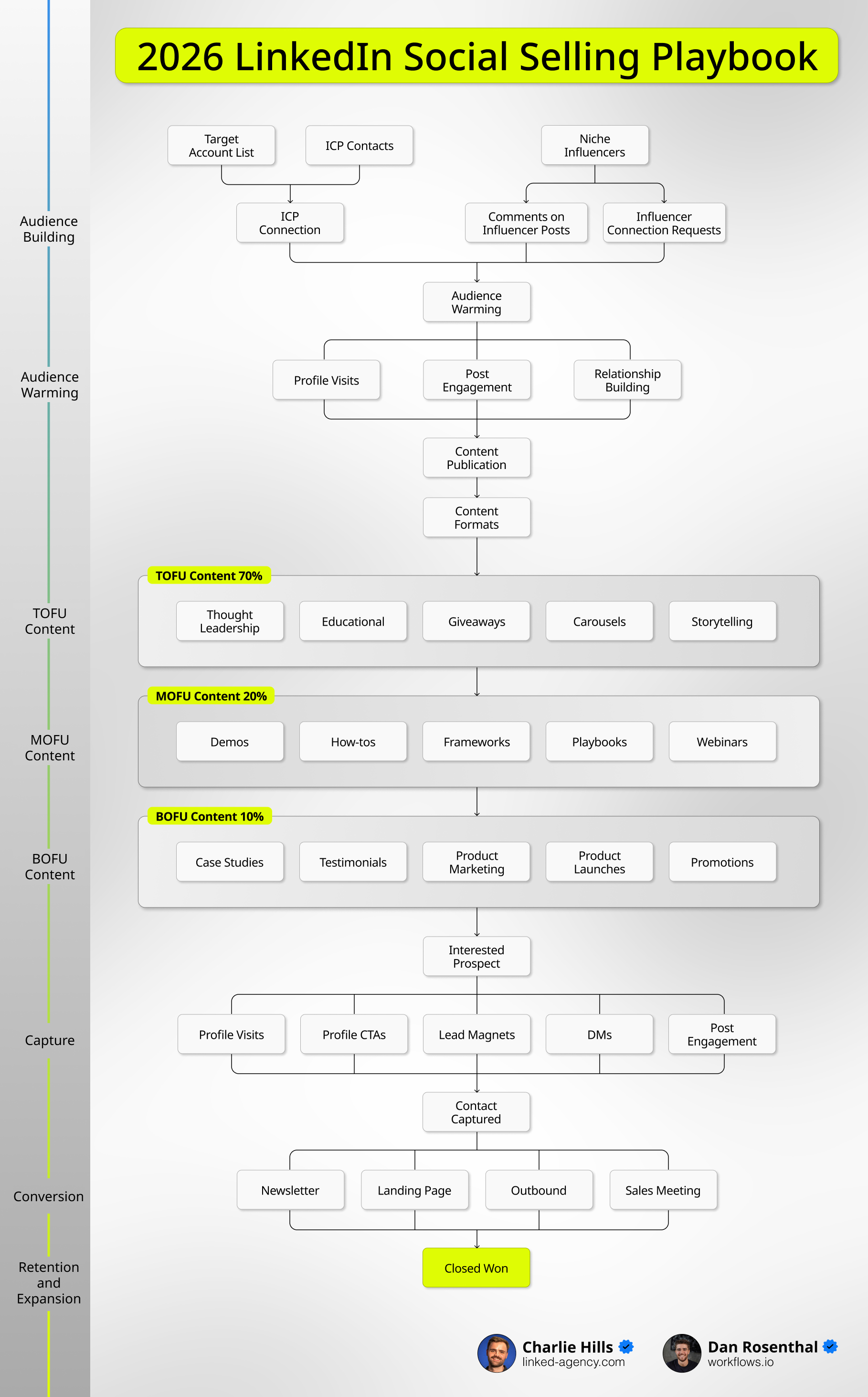
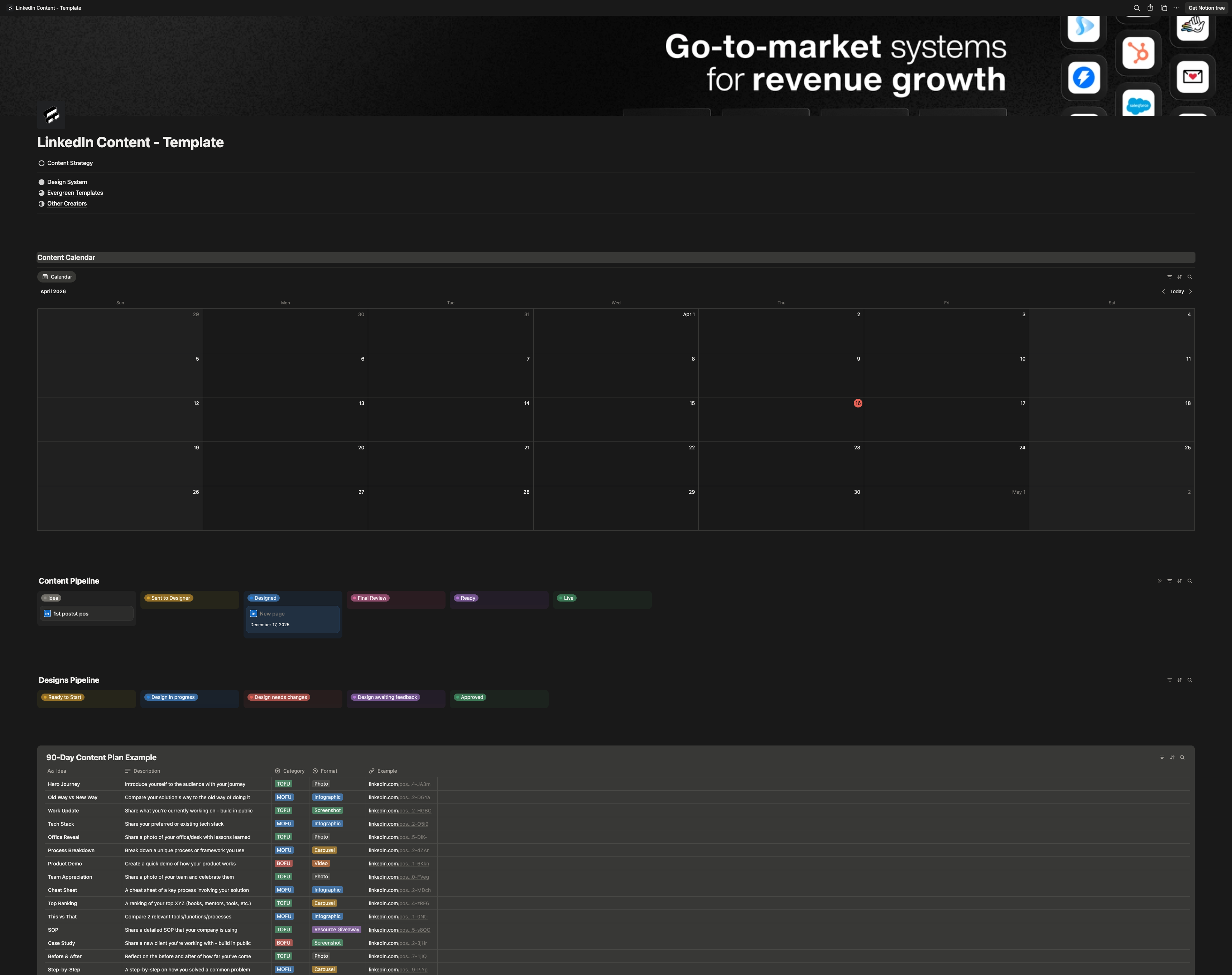
Each post is tied to a funnel stage (TOFU, MOFU, or BOFU), a specific format, and a real example from a creator who's done it well.
This is the exact system I'd use if I were starting from zero today. And in this post, I'll walk you through every piece of it.
How the 90-Day LinkedIn Posting Schedule Works
This plan runs on a simple cadence: three posts per week for 12 weeks. That's 36 posts total.
Why three? Because it sits in the sweet spot between consistency and burnout.
One post a week isn't enough to build momentum. The algorithm barely registers you, and your audience forgets you exist between posts. Five posts a week sounds ambitious, but most people flame out by week three. They run out of ideas, the quality drops, and they quit.
Three gives you enough frequency to stay visible without turning content into a full-time job. You can batch-write on a Monday and have the whole week scheduled.
The weekly structure is intentional too. Each week in this LinkedIn posting schedule includes one post from each layer of the funnel:
- One TOFU post: something that reaches new people. A personal story, an opinion, a resource that gets shared.
- One MOFU post: something that builds credibility with the people already paying attention. A framework breakdown, a process walkthrough, a comparison.
- One BOFU post: something that moves warm followers closer to a conversation. A case study, a product demo, a free audit offer.
This mix keeps your feed from becoming one-dimensional.
I've seen creators who only post TOFU content: big reach, lots of likes, zero pipeline. And I've seen others who only post BOFU: every post reads like a pitch and nobody engages. The balance is what makes the system work.
Spacing matters too.
Posting three times on Monday and going silent until the following week defeats the purpose.
Spread them out.
Monday, Wednesday, Friday works.
Tuesday, Thursday, Saturday works.
Pick a rhythm you can actually maintain for 12 straight weeks.
One thing to keep in mind: don't increase the frequency until you understand what's working.
Adding more posts before you've read your data just creates more noise. Start with three, learn from three, and scale later if it makes sense.
The 3 Content Layers: TOFU, MOFU, and BOFU
Every post in this LinkedIn content plan is tagged with a funnel stage. This tag determines the goal of the post, who it's trying to reach, and what it should get them to do next.
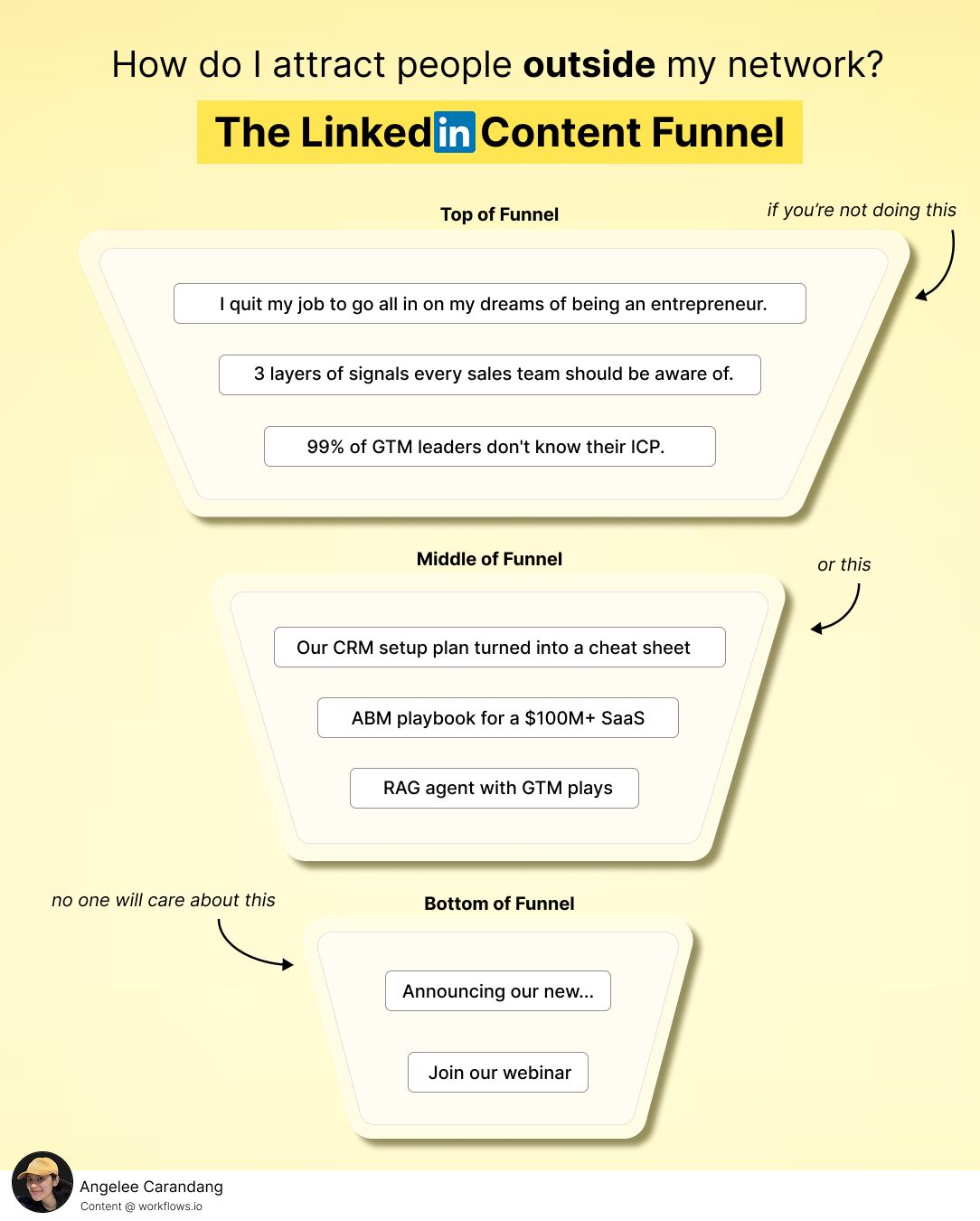
TOFU (Top of Funnel) posts are your discovery engine. Stories, opinions, resource lists, behind-the-scenes moments. The goal is reach. Get in front of people who've never seen your name.
MOFU (Middle of Funnel) posts build trust with the people already following you. Frameworks, process breakdowns, cheat sheets, tech stack posts. The goal is to show how you think and how you work.
BOFU (Bottom of Funnel) posts convert warm followers into leads. Case studies, product demos, free audit offers. The goal is to make it easy for someone to start a conversation.
Each week in this plan includes one of each. That balance is what keeps your content working across the entire funnel instead of only chasing reach or only pitching.
We break down how to build a full content funnel strategy in our LinkedIn Growth Guide.
The 12-Week LinkedIn Content Calendar Breakdown
Here's the full week-by-week plan.
Each week has three posts: one for each funnel layer. I'll walk through the three phases, explain why each post type exists where it does, and point you to real examples from creators who've executed these formats well.
The creators you'll see referenced throughout:
- Anthony Pierri
- Pierre Herubel
- Nick Broekema
- Dan Rosenthal
- Fivos Aresti
- Matt Lakajev
- Lara Acosta
- Charlie Hills.
All of them have strong track records with these exact formats. Study how they structure their posts. Look at their hooks, their visuals, their CTAs.
Then adapt the approach for your own experience and audience.
Weeks 1-4: Positioning
The first month is about answering one question for your audience: who are you and why should I pay attention?
You're introducing yourself, your work, and your point of view so that people have a reason to follow along.
Week 1 opens with a hero journey post: your story, told in a way that's relevant to the audience you want to attract.
Pair that with a work update (a screenshot of something you're actively building) and an old way vs. new way infographic that positions your approach against how things used to be done.
Week 2 shifts to value-first content.
Lead with a big resource list: "100+ prompts for SDRs" or "50 tools every founder should know." Posts like these get massive saves and shares because they're immediately useful.
Follow it with a tech stack infographic that shows the tools you use daily.
Close the week with a process breakdown carousel.
Week 3 mixes personal and product.
A map-style infographic (your industry landscape, tools in your space, events you're attending) gives your audience something to screenshot and reference.
Then bring in your first BOFU post: a product demo video. Keep it short. Show one specific thing your product does.
Week 4 wraps the positioning phase with practical resources.
Create a template your audience can actually use: a scoring sheet, a planning doc, an outreach sequence.
Add a cheat sheet infographic.
Close the month with a team appreciation post. A photo of your team with a genuine note about what they've been working on.
By the end of week 4, your audience should know who you are, what you work on, and how you think.
You've given them enough value to earn their follow. Now you go deeper.
Weeks 5-8: Authority
This phase is about proving you know your space at a level most people don't.
You're sharing systems, breaking down processes, and showing the thinking behind your decisions.
Week 5 starts with a feature update video.
If you're building a product, show what's new. Build in public: people love watching something come together in real time.
Pair that with a tech stack carousel (a repurposed version of your week 2 tech stack post, now in slide format).
Then add a top ranking infographic. "The 10 books that changed how I sell" or "My top 5 tools for prospecting."
Week 6 is process-heavy.
Share an actual SOP that your company uses. Not a polished marketing version but the real thing.
Follow it with a tech landscape infographic: a visual map of every tool in your category.
Close with a step-by-step carousel that walks through how you solved a specific problem.
Week 7 brings your first case study.
Share a screenshot of a result you've delivered for a client. Keep it specific: the problem, what you did, the outcome.
Balance that with a before-and-after photo post.
Then add an alternatives comparison infographic: bad, good, and best approaches to a common scenario.
Week 8 rounds out the authority phase.
Record a use case walkthrough: a screen recording of your product solving a specific problem for a specific type of customer.
Add a "this vs. that" infographic comparing two tools or approaches.
Close with a top ranking carousel, repurpose your week 5 ranking post into a swipeable format.
At this point, your audience sees you as someone who operates at a high level. You've shared your tools, your processes, your results.
The people still paying attention are warm. Time to convert.
Weeks 9-12: Conversion
The final phase is about proof and activation.
You've built the audience. Now you show them what working with you looks like and give them a clear path to start a conversation.
Week 9 opens with a handraiser post, a direct offer.
"Drop a comment and I'll send you a custom audit of your outbound process." Or "Reply 'plan' and I'll send you our internal content calendar."
This qualifies the interested people in your audience.
Follow it with an announcement post, a milestone, a new hire, a new client.
Close with another cheat sheet infographic for a tool you use heavily.
Week 10 repurposes and sharpens.
Take your SOP giveaway from week 6 and turn it into a carousel that breaks down the key steps.
Add a news commentary post, screenshot a trending headline and share your take on it.
Then post a product overview infographic that gives a clear visual summary of what your solution does and who it's for.
Week 11 gets personal again, but with more weight behind it.
Share your most painful or expensive mistake and what it taught you.
Follow that with a dos-and-don'ts infographic that applies those lessons to a scenario your audience faces.
Then compile everything you've published: templates, cheat sheets, SOPs into a single playbook.
Week 12 closes the 90 days strong.
Break down a full case study in infographic format.
Share your playbook as an ungated PDF.
End with a reflection post. If you were starting over today, what would you do differently?
By week 12, you've published 36 posts across every funnel stage.
You have data on what works, a library of content to repurpose, and an audience that knows exactly what you do and how you think.
What Happens After 90 Days of Posting on LinkedIn
90 days is the starting line, not the finish.
By the end of this plan, you'll know things about your audience that you can't learn any other way. Which topics get saved. Which formats get shared. Which posts drive profile visits. Which ones generate DMs.
That data changes everything about how you plan your next quarter.
Here's what the timeline actually looks like based on what I've seen across clients:
- At 3 months, you know what works. You stop second-guessing every post because you have real data.
- At 6 months, people recognize your name before they read your post.
- At 12 months, you have 5+ figures of relevant followers, inbound DMs, and conversations that start with "I've been following your content."
The key word there is relevant.
A big follower count means nothing if it's the wrong people. This plan builds an audience of people who actually care about what you do because every post is mapped to a funnel stage, not just optimized for likes.
That's when LinkedIn stops feeling like a chore and starts feeling like a channel that compounds.
How to Make This LinkedIn Content Plan Your Own
One thing I want to be direct about: this plan is a system, not a script.
You can't copy the post types word for word, plug in your logo, and expect results. The structure works. The formats are proven. But the content has to come from you.
Every post needs your lived experience in it.
When the plan says "share a case study," that means your case study. A real client, a real problem, a real result. When it says "post a lessons-learned story," that means a mistake you actually made, not a generic insight about perseverance.
The creators referenced in this plan use these same formats. But each of them sounds completely different because they bring their own stories, opinions, and expertise to every post.
That's what you need to do too. Use the plan as your roadmap. But drive it yourself.
Get the 90-Day LinkedIn Content Plan Template
Everything in this post is built into an editable template you can start using today.
It includes the full 12-week calendar, post descriptions for every slot, funnel tags for each post, format labels, and links to real examples from the creators mentioned above.
You can customize it for your audience, your pillars, and your positioning then use it as your operating system for the next 90 days.
Conclusion
People overestimate what one post can do for them. They spend three hours crafting the perfect hook, publish it, and measure the results like their entire LinkedIn strategy depends on that single moment.
It doesn't work that way.
One post is a data point. 36 posts is a dataset. And a dataset is what actually tells you where to go next.
The people who build real audiences on LinkedIn aren't better writers on day one. They just stayed in the game long enough for the patterns to show up. 90 days of consistent posting will teach you more about your audience than a year of sporadic content ever could.
That's the real takeaway here. Stop optimizing individual posts. Start building the system that makes every post smarter than the last.
If you're looking to build a content system like this for your team, book a call with us.
Explore our full library of GTM workflows.
And if you want to follow along as we share new GTM experiments and playbooks, subscribe to our newsletter.