

Outbound has changed a lot in the last few years.
Reply rates on cold emails have come down. A generic message to a list pulled from Apollo doesn't produce what it used to. The motion still has a place, but the ceiling on what it can do has lowered.
What works now is more specific.
When a prospect has done something recently, like visit your pricing page or engage with your team's content, and you reach out the same day with a message that mentions what they did, your reply rates go up 3 to 5 times.
That's signal-based outbound. It doesn't replace cold outbound. It sits on top of it for the accounts that matter most. Cold outbound still works fine for everything else.
We've run hundreds of outbound campaigns at workflows.io. Some for our own pipeline, most for clients. These are the five plays that come out on top, every single time.
Here's how each one works, and the tools we use to run them.
What makes signal-based outbound plays work
A play that works starts with a signal, rather than just a list of contacts.
Something happened recently that hints they're in the market: a post about a problem you solve, a visit to your pricing page, a like on one of your team's LinkedIn posts, or a job change away from a company that used to buy from you.
Then you turn that signal into a sequence of emails and LinkedIn DMs in your voice. The first message has to mention what the prospect actually did, in a way that's specific enough for them to recognize, not a generic line like "saw your company is doing well."
These plays work because of timing more than copy. Your message lands while your space is still fresh on the prospect's mind, and the response rate goes up because of that.
For the underlying messaging framework that supports all five plays, see the cold outreach message playbook.
The 5 outbound plays winning in 2026
These five plays cover the signal types that get the highest replies at workflows.io and at the clients we run outbound for. Each one works on its own. They get even better when you stack them.
1. Customer alumni
Some of the warmest leads you can find are people who used to work at companies that already bought your product, because when they move to a new company, that new company becomes a strong target with a built-in champion inside.
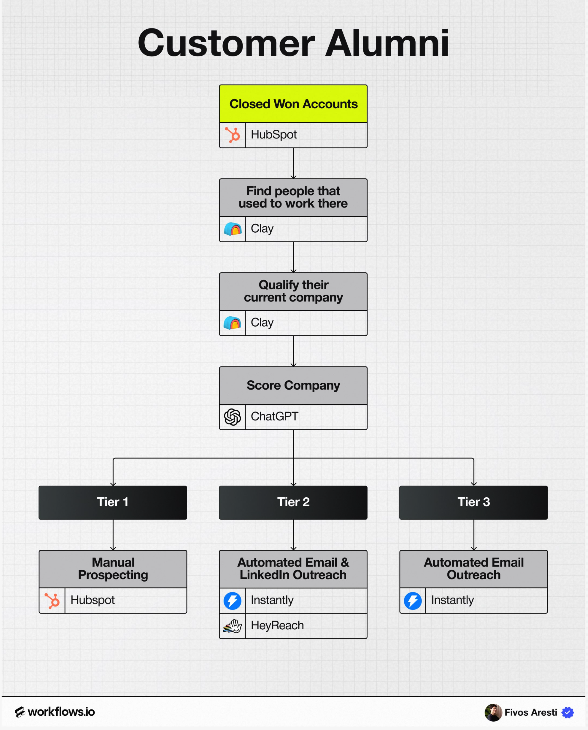
The play surfaces those former employees, qualifies the new company against your ICP, and tiers them for the right kind of outreach.
How to run it:
- Pull closed-won accounts from HubSpot
- Use Clay to find people who used to work at those accounts and have since moved
- Qualify their current company in Clay against your ICP
- Score each company using ChatGPT model to assign it to Tier 1, 2, or 3
- Route outreach by tier: Tier 1 gets manual prospecting in HubSpot, Tier 2 gets automated email and LinkedIn DMs through Instantly and HeyReach, and Tier 3 gets automated email through Instantly
For the full step-by-step, see the customer alumni play.
2. LinkedIn connections
Your LinkedIn network is already full of qualified leads, sitting there from years of connection requests that were always meant for prospecting later.
The play reactivates those connections, qualifies the ones that fit your current ICP, and sends them into targeted outbound campaigns.
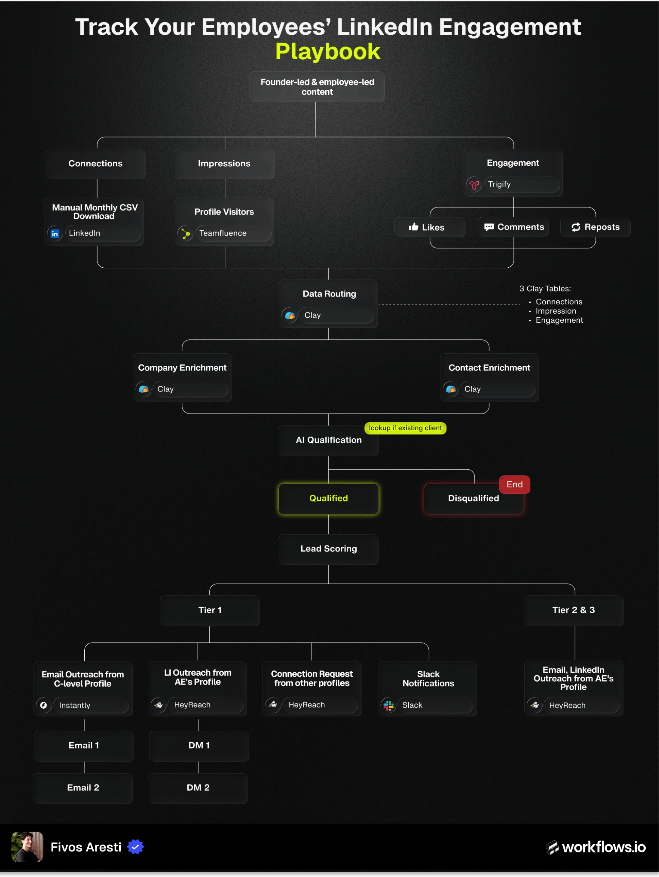
How to run it:
- Download your entire LinkedIn connections list
- Run them through Clay for qualification against your current ICP
- Enrich company and contact data with Findymail
- Reach out with segmented campaigns using HeyReach
The connection request was the warm trigger. You earned that. The follow-up does not feel cold because there is a real reason you are already connected.
For the full workflow that turns connections, profile visitors, and post engagement into outbound, see the LinkedIn employee engagement playbook.
3. LinkedIn content engagement
If your team posts on LinkedIn, your content is already doing the prospecting work for you, with every like, comment, and reshare flagging someone who pays attention to what your team has to say.
The play captures that engagement across your team's posts, qualifies the engagers against your ICP, and turns them into outbound targets the same week.
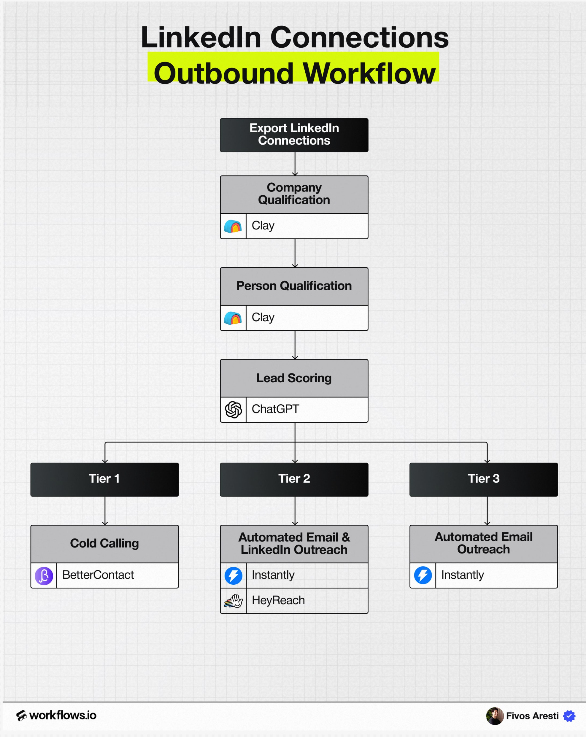
How to run it:
- Track post engagement across your team with Jungler
- Route the engagement data to Clay to qualify and score the engagers
- Filter based on how many times they engaged, since repeat engagers are the strongest signal
- Reach out using HeyReach for LinkedIn DMs and Instantly for email
This play also feeds an awareness scoring layer in your CRM, where every engagement raises an account's awareness score until it triggers an outbound sequence.
For the awareness scoring side, see how to build a signal architecture for go-to-market.
The companion play around your founder's network specifically is in the founder connections playbook.
4. Keyword monitoring
Buyers talk about your space on LinkedIn every day, and few teams listen in on those conversations.
The play tracks the right keywords and brand mentions, finds the people posting and engaging, and turns them into outbound targets the same week.
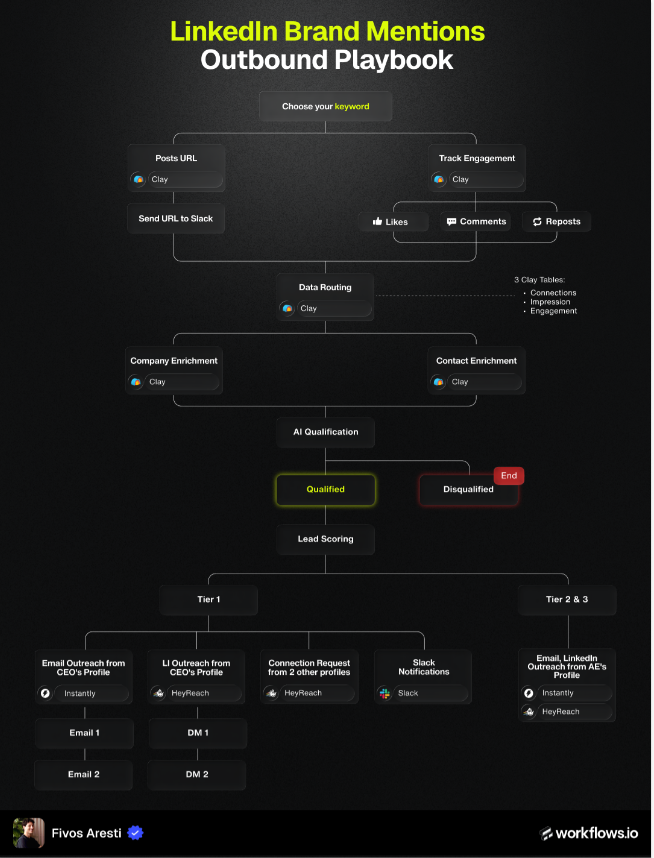
How to run it:
- Monitor relevant keywords and brand mentions with Jungler
- Get the list of people engaging with those posts
- Send the list to Clay for enrichment and qualification
- Find decision-makers at each account and send automated multichannel sequences
For the brand mention monitoring side, see the LinkedIn brand mentions outbound playbook.
5. Website visitor de-anonymization
Your website is generating signals you can't see by default, and de-anonymization tools make them visible the moment a prospect lands on a high-intent page like pricing or your compare page.
The play captures the visit, enriches the contact, multi-threads to other decision-makers at the same company, and ships outbound the same day.
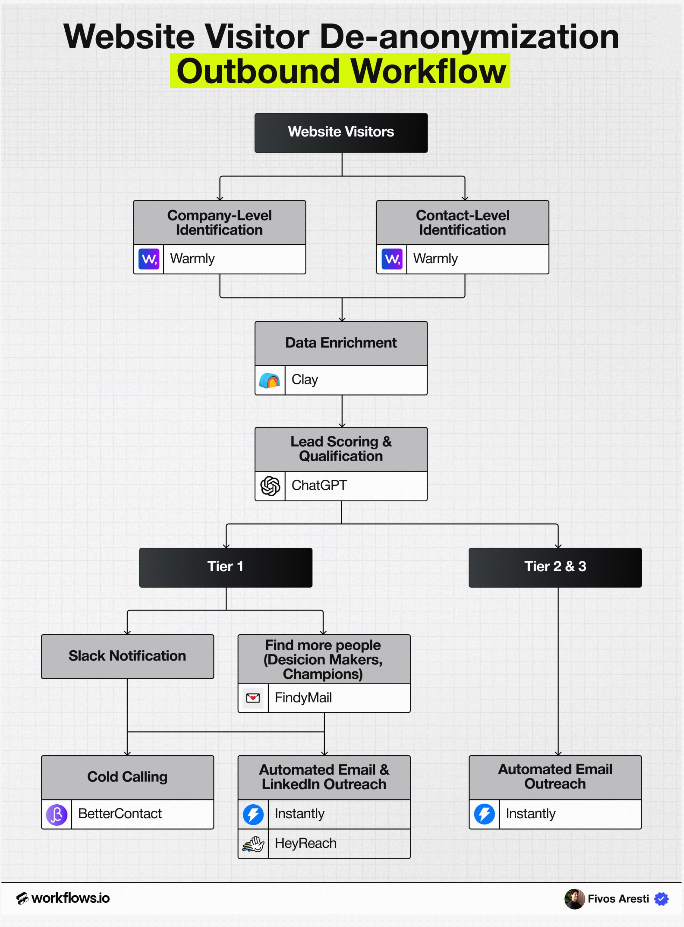
How to run it:
- Connect the RB2B pixel to your website to get visitor data at the contact level
- Route the data to Clay for AI qualification against your ICP
- Find additional decision-makers at the same company to multi-thread the account
- Send a multichannel sequence referencing what the prospect actually visited
For the full step-by-step, see the website visitor de-anonymization playbook.
How to layer these plays for compounding pipeline
One play on its own works. Multiple plays running as one system work much better. Each play feeds the next.
A prospect visits your pricing page. RB2B captures the signal. Before your team reaches out, Clay enriches the account and identifies four other decision-makers. The outbound launches across email and LinkedIn DM.
One of those decision-makers engages with your founder's LinkedIn post the next day. Jungler captures that engagement and raises the account's awareness score. Your AE gets a Slack alert that a Tier 1 account just engaged a second time.
Now you have a triple-signal account inside a week. And no one had to track it manually.
That's where the compounding comes from. Each play adds another signal to the same account. Your team can multi-thread the outreach, and every new opener gets sharper.
For the agent layer that orchestrates these plays through Claude Code, see the Claude Code skill library breakdown.
Where outbound plays go wrong
A few things tend to go wrong when teams try to ship these plays.
- Running the play without qualification: Not every signal is buying intent. Without Clay or a similar tool filtering for ICP fit, you end up emailing the same junior recruiter who likes every B2B post on LinkedIn.
- Sending only email: A single email to a Tier 1 account is not enough. The play needs LinkedIn DMs, email, and sometimes a phone call, all timed to the signal.
- Treating signals like cold leads: The signal is your opener. The first message has to mention it directly. A "saw you visited our pricing page" email gets a very different response than a "wanted to reach out" email.
- Building it manually: A team running these plays by hand can ship one or two campaigns a quarter. A team running them through Clay and Claude Code can ship a dozen.
Conclusion
One play gives you one channel of pipeline. Five plays running together give you a flywheel.
Teams running these plays in 2026 are hitting their pipeline targets without hiring more SDRs. Teams leaning entirely on cold outbound at volume are spending more to get less every quarter.
If you want help running these five plays in your own stack, book a strategy call. We'll look at your current outbound and figure out which play to ship first.